
Embarking on a journey with an infant can be an exhilarating yet daunting experience. From packing countless essentials to navigating airport logistics, parents often find themselves juggling multiple tasks. While many focus on strollers, car seats, and an endless supply of diapers, one critical element often gets overlooked: the necessary travel documents for your baby. This comprehensive guide will equip you with all the vital information you need to ensure a smooth, stress-free travel experience, detailing everything from airline-specific requirements to applying for an infant’s passport.

As parents, we constantly strive to be over-prepared for any potential challenges when traveling with our little ones. Our checklist typically includes everything imaginable: a well-stocked diaper bag, a compact travel stroller, a portable car seat, an ample supply of baby food and breast milk, comforting toys, an iPad for entertainment, a security pacifier, and emergency changes of clothes. We’ve mastered the art of packing essentials, but our recent travels unveiled a lesser-known aspect that caught us off guard: understanding the specific documentation required for infants.
The question often arises: Does a one-year-old, who doesn’t even need their own plane ticket yet, truly require official records to fly? The answer, surprisingly, is both yes and no. This ambiguity is precisely what adds stress for parents, as if the complexities of travel weren’t enough already. Our biggest oversight was assuming that all major airlines would have consistent ID requirements for infants. This crucial detail varies significantly from one carrier to another, making pre-trip research absolutely essential.
We’ve previously shared extensive tips for traveling with a baby and highlighted our essential baby travel gear. However, we’ve never delved into the intricacies of the documents needed for travel – the fundamental first step to smoothly navigating airport security and boarding your flight. Fortunately for you, our meticulously compiled checklist aims to save you countless hours of endless online research. We’ve consolidated the proper identification requirements for boarding your baby, whether your journey takes you across the country or around the globe.
With your documents in order, all that’s left is hoping for a patient flight attendant and, ideally, a sleeping baby for a peaceful journey!

How Old Does a Baby Have to Be to Fly?
Before delving into the specific documents you’ll need, a common and important question for new parents is: “How old does a baby have to be to fly?” This decision often comes down to parental comfort and a pediatrician’s advice, as newborns possess delicate immune systems and air travel can expose them to various germs and pressure changes.
Generally, most airlines permit infants to fly as early as two weeks old. However, it’s crucial to understand that individual airlines maintain their own policies regarding newborns, with some requiring a baby to be at least seven days old, while others might ask for a doctor’s note for infants under two weeks. Our strong recommendation is to consult your pediatrician to ensure your baby has undergone all necessary health checks and received appropriate vaccinations before planning any air travel. Additionally, always confirm the specific infant travel policy directly with your chosen airline, especially if your baby is less than a month old.
Once deemed old enough and healthy for travel, infants under the age of two can typically fly as “lap infants” without requiring a separate purchased seat. This allows parents to hold their baby throughout the flight, saving on ticket costs. However, even as a lap infant, your baby will still need proper identification, which we will detail in the following sections.

Flying with a Baby On Major Airlines in the U.S.
Understanding the varying ID requirements across major U.S. airlines is key to a hassle-free check-in process. While some general rules apply, each airline has specific nuances. Always remember that policies can change, so a quick check on the airline’s official website before your trip is always advisable.
American Airlines
- Domestic travel: American Airlines requires proof of age for infants, such as a birth certificate. This helps verify that your child is indeed under two years old and eligible to fly as a lap infant.
- International travel: For all international flights, a passport is mandatory for your infant. Additionally, if a child is traveling internationally without both parents, a notarized letter of consent from the absent parent(s) may be required. Be aware that a lap-child on an international flight will still need their own separately booked ticket, typically incurring a fee equivalent to 10% of your adult ticket price plus applicable taxes.
Delta Airlines
- Domestic travel: Children under 18 traveling domestically are generally not required to show ID on Delta. Uniquely, Delta allows for a limit of two infants (in arms) per adult in one seat, making it a flexible option for parents traveling with twins or two very young children.
- International travel: A passport is required for all infants traveling internationally with Delta. Similar to other airlines, a lap-child will still require their own ticket, which typically costs 10% of the adult fare plus any relevant international taxes and fees.
Frontier Airlines
Frontier Airlines may request a birth certificate for age verification purposes if an infant’s age appears questionable at check-in or boarding. This is primarily to confirm eligibility for lap infant status. For international flights, a passport will always be required.
Hawaiian Airlines
- Domestic travel: For flights within the U.S., including to Hawaii, a birth certificate (a copy is permitted) or a passport is required as proof of age for infants.
- International travel: A valid passport is essential for infants flying internationally with Hawaiian Airlines.
Jetblue Airlines
- Domestic travel: JetBlue accepts various forms of proof of age for infants flying domestically, including a birth certificate (photo or digital copies are acceptable), an immunization record, or a passport. This flexibility can be very convenient for parents.
- International travel: As with all international journeys, a passport is required for your infant.
Southwest Airlines
Based on our experience, Southwest Airlines often provides one of the easiest domestic travel experiences with a baby. While a traditional boarding pass isn’t required for your infant, you will need a “Boarding Verification Document.” We recommend arriving early at the airport and bringing a copy of your baby’s birth certificate to obtain this document from the ticket counter.
International travel: For international flights, a birth certificate or a passport is required to validate the age of all infants under two. Crucially, a passport is always necessary for any international travel. Southwest is notable for its more favorable policy regarding international lap infant fees; taxes and fees apply to lap children flying internationally, but these are typically much lower than the standard 10% airline charges, making it a more budget-friendly option for international family travel.
United Airlines
- Domestic travel: For domestic flights, children under 18 are not required to show ID with United Airlines.
- International travel: A passport is mandatory for infants on international United flights. A separate lap-child ticket must be purchased, which is typically equivalent to the taxes paid on the adult ticket price, rather than a percentage of the fare.
Important Things to Know About Getting a Passport for a Minor
Navigating the passport application process for adults can be straightforward, but applying for a child’s passport introduces a unique set of complexities. Many parents, like us, might only be familiar with renewing their own passports. However, when it came to obtaining a passport for our baby, we quickly realized it’s a far more involved procedure. This heightened complexity is not arbitrary; it’s a critical measure implemented to enhance child safety and prevent international abductions, ensuring that both parents consent to the child’s international travel.
These extra steps, while seemingly burdensome, are designed to protect minors. Understanding these requirements beforehand will significantly reduce stress and ensure your child’s passport application proceeds without delays. Here are some essential tips we gathered from our experience:
9 Helpful Tips When Preparing Travel Documents for Infants:
Here are invaluable insights we gained while preparing travel documents for our infant:
- Apply for the passport at least 6 weeks before your trip: The processing times can fluctuate, especially during peak travel seasons. Allowing ample time, ideally 6 to 8 weeks, minimizes the risk of last-minute panic and ensures your baby’s passport arrives well before departure.
- Speed up the application process by filling out one online, but do NOT sign it beforehand: The DS-11 form needs to be signed in front of a Passport Acceptance Agent. Pre-signing it will invalidate the form and require you to restart the process.
- Avoid the long lines and schedule a passport appointment at your local USPS office: Many post offices offer passport services by appointment, which can save you significant waiting time compared to walk-in services. Libraries and other designated facilities also offer these services.
- Both parents and child must be present to apply in person: This “two-parent consent” rule is fundamental for minors. If one parent is unable to appear, they must provide a notarized consent form (DS-3053), along with a copy of their government-issued ID, affirming their permission for the child’s passport to be issued.
- Both parents must bring a government-issued photo ID: This could be a driver’s license, a state-issued ID card, or a previous passport. These IDs are necessary to verify the identity of the parents and their relationship to the child.
- You will need 2 color photos of your child: Ensure these photos meet strict passport photo requirements: a plain white background, no shadows, the child’s eyes open and looking at the camera, and a neutral expression or slight smile. No pacifiers or hats are allowed.
- Save money and take your own passport photo using this template: Instead of paying $15+ at an office, you can often take a compliant photo at home against a white sheet and print it for a fraction of the cost, sometimes as little as 30 cents, at a local photo printing service.
- You’ll have to turn in your child’s original birth certificate! Don’t be alarmed: We were initially very hesitant to part with Gwen’s only official ID. However, this is standard procedure. The passport office will mail back your child’s original birth certificate (usually separately from the passport) in about 10 business days after processing, or you may receive it when picking up the passport in person.
- Who signs your baby’s passport? A parent must print their child’s name: Since infants cannot sign their own names, one parent must sign on the child’s behalf. This involves printing the child’s full name on the signature line, followed by the parent’s signature and a notation indicating their relationship (e.g., “Parent” or “Mother/Father”).
Fast-Track Through Customs with Global Entry
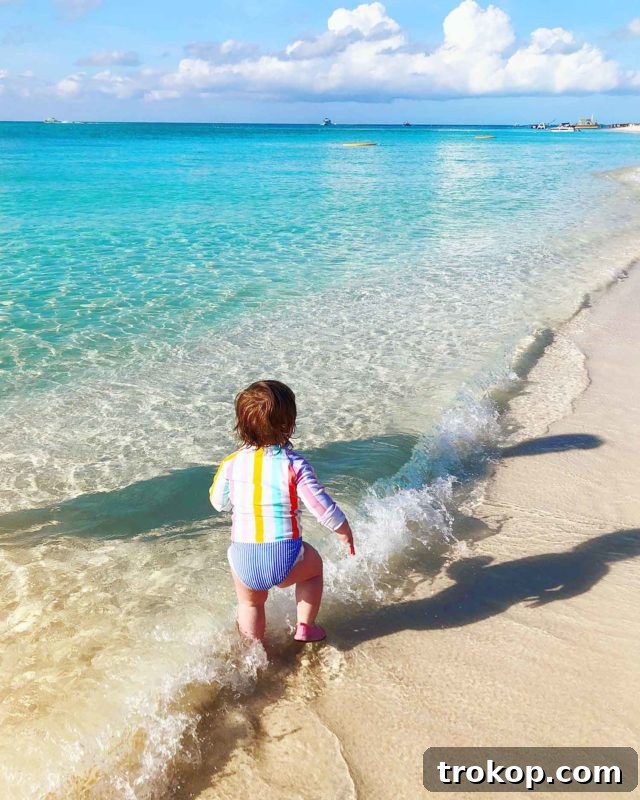
For families planning international travel, we enthusiastically recommend applying for Global Entry. It is an absolute game-changer for navigating customs and immigration with ease. During our recent international trip to Turks & Caicos, having Global Entry allowed us to zip through customs within 15 minutes, a welcome relief after a long flight with a baby!
A critical detail that many parents overlook, and one that initially surprised us, is that every individual, including your baby, must have their own Global Entry card. Your Global Entry status does not extend to your child. We mistakenly assumed our membership would cover Gwen, leading to a moment of potential delay. It’s hard to imagine an infant orchestrating a terrorist attack or smuggling illegal goods, but the rules are non-negotiable for all travelers!
What is Global Entry?
Global Entry is a U.S. Customs and Border Protection (CBP) program that provides expedited clearance for pre-approved, low-risk travelers upon arrival in the United States. In addition to fast-tracking international arrivals, Global Entry membership also includes TSA PreCheck status for domestic flights, streamlining your entire airport experience.
Membership is valid for five years. Members bypass traditional customs lines and instead process their entry at an automated kiosk. The application process, while requiring an in-person interview, is generally straightforward for adults. Furthermore, many premium credit cards offer a statement credit to waive the $100 application fee, making it an even more attractive option.
As mentioned, our assumption that Gwen wouldn’t need her own Global Entry because both of us were members proved incorrect. Fortunately, a kind customs officer processed Gwen through without redirecting us to the regular, often lengthy, security lines. However, relying on the leniency of an officer is not a strategy. To guarantee a smooth re-entry into the U.S. after an international flight, especially with an infant, ensure every family member, including your baby, has their own valid Global Entry membership.

Air Travel: Must-Have Paperwork for Flying Internationally
When traveling internationally by air, every single person in your family, including your baby, requires their own valid passport and a boarding pass. This applies whether your baby will be a lap infant or occupies a purchased seat. A passport is the universal key to international air travel. Beyond passports, if your chosen destination mandates a travel visa for entry, your infant will also need their own individual visa. For alternative modes of international travel, such as by land or sea (e.g., a cruise to certain destinations), babies may only require their birth certificates, but always verify specific country and carrier requirements well in advance.
Travel Tip: Keep Digital Copies of All Your Documents
Organizing and preparing all your travel documents beforehand significantly contributes to a smoother flight experience. We’ve found it incredibly helpful to keep all essential paperwork—passports, birth certificates, boarding passes, and any necessary consent letters—securely together in a designated folder within our carry-on bag, ensuring they are easily accessible and don’t accidentally get mixed up with checked luggage.
Beyond physical copies, a crucial safety measure is to always have digital backups of all your important documents. There are countless horror stories of travelers losing their IDs or passports overseas. To prevent this, scan or take clear photos of passports, visas, birth certificates, and flight itineraries. Store these digital copies in multiple secure locations: on your phone, uploaded to a secure cloud service (like Google Drive or Dropbox), and emailed to yourself or a trusted family member. This way, if physical documents are lost or stolen, you have accessible records to assist with replacement processes, making any unforeseen mishaps significantly less stressful.
The best overarching tip we can offer when flying with an infant is to always factor in extra time. Allocate extra time for packing, more time to get to the airport, and certainly additional time to navigate airport security. Trust us, rushing through the airport with a baby, especially one who might be fussy or experience unexpected travel hiccups, is an unnecessary source of stress. Planning with a generous time buffer allows you to handle any situation calmly, ensuring you can focus on enjoying the journey and anticipating your vacation!
Frequently Asked Questions When Flying with a Baby
What if your kid is a seat kicker?
Flying with a baby can be a mix of excitement and challenges, and dealing with a “seat kicker” can certainly test a parent’s patience, as well as that of fellow passengers. To mitigate this, proactive planning is key. First, consider your child’s seating arrangement. If possible, opt for an aisle seat, which allows easier access to stand up and stretch your child’s legs without disturbing others. A bulkhead seat can also provide more space and prevent kicking the seat in front. If it’s within your budget, flying first or business class typically offers significantly more legroom and additional amenities designed for comfort, which can help keep your child occupied and prevent kicking.
Beyond seating, engage your child with various activities. Bring new, engaging toys or books that can hold their attention for longer periods. Snacks are also powerful distractions! Timing your flights around nap times can be highly effective, as a sleeping child is a calm child. Lastly, remember to communicate politely with your child and, if necessary, with other passengers. A simple apology and a visible effort to manage the situation often go a long way in maintaining a positive atmosphere.
Do babies need an I.D.?
Yes, babies absolutely need identification when flying. While they might not carry a driver’s license, you will need to present identification for your child, even if they are flying as a lap infant. For domestic travel within the U.S., a child’s birth certificate is the most commonly accepted form of identification. This document serves to verify their age, ensuring they meet the requirements for lap infant travel. Depending on the specific airline, other forms of ID like an immunization record or a digital copy of the birth certificate might be accepted, so always check with your carrier.
For international flights, the identification requirements become more stringent. A valid passport is mandatory for your child, regardless of age or whether they have their own seat. It is crucial to ensure your child’s passport is properly validated, up-to-date, and has sufficient validity remaining for your destination. Some countries also require a visa for infants, so research your destination’s entry requirements thoroughly.
More Travel Tips
Enjoyed this comprehensive guide on travel documents for infants? Be sure to explore our other valuable resources for flying with a baby! Having traveled with Gwen since she was born, we’ve accumulated a wealth of tried-and-true favorites and essential advice to share.
- Must-have travel stroller, travel car seat, and baby gear
- Our tips for traveling with a baby
- Our favorite baby products to register for
- The Best Luggage for Kids
- My Current Favorite Baby Sunglasses for Gwen
- Little Sugar & Cloth: Diaper Bag Essentials + My ToteSavvy Hack!
- My Easy Self-Care Tips for Feeling Confident in Yourself (Especially After Baby)
- Things I Didn’t Know About Basic Financial Planning + Insurance Until Having A Family
- Real Talk With Real Moms: Our Thoughts on Going from One Kid to Two!